
Demand follows documented scarcity, not collector hype.
Australia’s 50-cent coin market operates strictly on mathematical mintage figures.
Pricing in 2026 demonstrates a direct correlation between value and confirmed emission volumes.
Rare, most wanted valuable rare australian 50 cent coins exist primarily due to changes in metal composition or errors during die manufacturing.
Production Period | Shape | Metal Composition | Weight | Diameter |
1966 | Round | Silver and Copper | 13.280 grams | 31.50 mm |
1969 — Present | Dodecagon | Copper and Nickel | 15.550 grams | 31.65 mm |
Modern dodecagonal coins possess a thickness of 3.00 mm.
Twelve-sided shapes were introduced to simplify tactile differentiation from other denominations.
Rising prices for precious metals led to the withdrawal of 1966 round coins from circulation.
Current values for these silver pieces never drop below the intrinsic metal worth.
Breakdown of the 1966 Silver 50-Cent Anomaly
This issue represents the only instance of mass silver usage for this denomination in Australia.
Total mintage reached 36,450,000 units.
Despite the high volume, the number of surviving specimens in Uncirculated condition remains limited.
1966 Silver Value Factors in 2026:
Silver content accounts for 80% of the total weight
Per-gram silver prices directly establish the minimum price floor
MS65 grade premiums reach 45% above the raw metal value
Presence of original mint luster doubles the price compared to tarnished examples
One specimen in MS67 grade reached a record $1,200.00 AU at a 2025 auction.
Annual value growth for coins in perfect condition sits at 7% due to the ongoing withdrawal of metal from the public supply.
Melting millions of coins in the 1970s created an artificial shortage of high-quality samples.
The 2000 Incused Flag: A Technical Die Failure
Millennium celebration coins became the primary focus for market analysts due to a specific strike error.
Preparing the dies incorrectly resulted in an incused representation of a flag segment.
Union Jack elements on the flag appear recessed into the surface instead of raised.
2000 Incused Flag Statistical Data:
Standard coin total mintage: 16,600,000 units
Estimated error coin quantity: fewer than 200,000 units
Detection probability in 2026 circulation: 0.001%
Fine condition price: $30.00 AU
Uncirculated condition price: from $1,200.00 AU to $3,500.00 AU
Prices for this specific type surged by 210% over the last five years.
Locating such a coin requires thorough inspection via a coin value checker.
→ Standard coin → Raised flag lines → Face value
→ Die error → Recessed flag lines → Rarity status
Pricing Dynamics of Low-Mintage Dates (1969–2026)
Market reports confirm the leadership of specific years based on price appreciation rates.
Data originates from weighted averages of public auction results.
Year | Mintage (Millions) | 2025 Price Growth | MS65 Average Price |
1972 | 0.4 | +12% | $180.00 AU |
1973 | 4.0 | +5% | $85.00 AU |
1974 | 2.5 | +8% | $110.00 AU |
1985 | 1.0 | +15% | $240.00 AU |
Low mintage in 1972 makes this year the most desired among standard twelve-sided coins.
Absence of 1972 coins in most contemporary bank sets increases their scarcity.
The mint reduced production in 1985 due to sufficient coin reserves in the system.
This led to a stable deficit forty years after the initial release.
Mint Error Coins: Non-Systemic Value
Classifying defects allows for determining the potential profitability of an asset.
Errors confirmed by reputable laboratory certificates command higher prices.
Double Strike: repeated die impact with a shifting blank
Prices for a specimen with a 15% shift reach $2,800.00 AU.
Wrong Planchet: striking on a blank intended for a different denomination
A 50-cent coin struck on a 20-cent Copper and Nickel blank sold for $15,500.00 AU.
Clipped Planchet: a coin missing a segment of its metal disk
Values fluctuate between $100.00 AU and $600.00 AU depending on the cut size.
Split Die: die cracks leaving raised lines on the coin surface
Small cracks add $20.00 AU to the price, while major cracks add up to $450.00 AU.
Statistics for 2026 indicate a 14% annual rise in interest regarding technological errors.
Using automated control systems at the mint reduces the probability of errors entering circulation.
Scarcity of new errors provokes aggressive demand for older discoveries.
Long-Term Investment Impact of "Proof" State
High-quality coins produced using specialized techniques appear only in limited sets.
These items were never intended for use as a legal tender in daily transactions.
Characteristics of Australian Proof 50c:
Mirrored fields without any visible scratches
Frosted relief on the central image
Hermetic capsules remaining a mandatory condition for preservation
Set Name | Year | Mintage (Sets) | 2026 Value |
Royal Visit | 1970 | 40,000 | $120.00 AU |
Silver Jubilee | 1977 | 65,000 | $95.00 AU |
Commonwealth Games | 1982 | 98,000 | $75.00 AU |
Excessive supply of certain 1980s sets explains their price stagnation.
Investors in 2026 prefer coins with mintage figures below 10,000 units.
Precious metal issues in Proof condition demonstrate higher resistance to market fluctuations.
Financial Consequences of the Grading Process
Professional evaluation of a coin's condition serves as the key factor in price legitimacy.
Utilizing third-party expert services eliminates seller bias.
→ Achieving MS64 grade → Standard market price → $55.00 AU
→ Achieving MS66 grade → Premium market segment → $450.00 AU
→ Achieving MS68 grade → Unique auction lot → $3,200.00 AU
Value differences between neighboring scale levels can reach 800%.
Buyers in 2026 refuse to purchase expensive coins without a certified holder.
Plastic containers protect the metal from oxidation and mechanical damage.
Digital certificates allow for tracking the ownership history of a specific coin.
Role of Design Variations in Rarity
Australia frequently utilizes the 50-cent coin for commemorative releases.
Changing the reverse while keeping the obverse constant creates short-term demand spikes.
1970 Cook Bicentenary: the first commemorative twelve-sided coin
Mintage of 16,500,000 units limits price growth.
1977 Silver Jubilee: commemorating the 25th anniversary of the reign
High availability makes this coin interesting only in perfect condition.
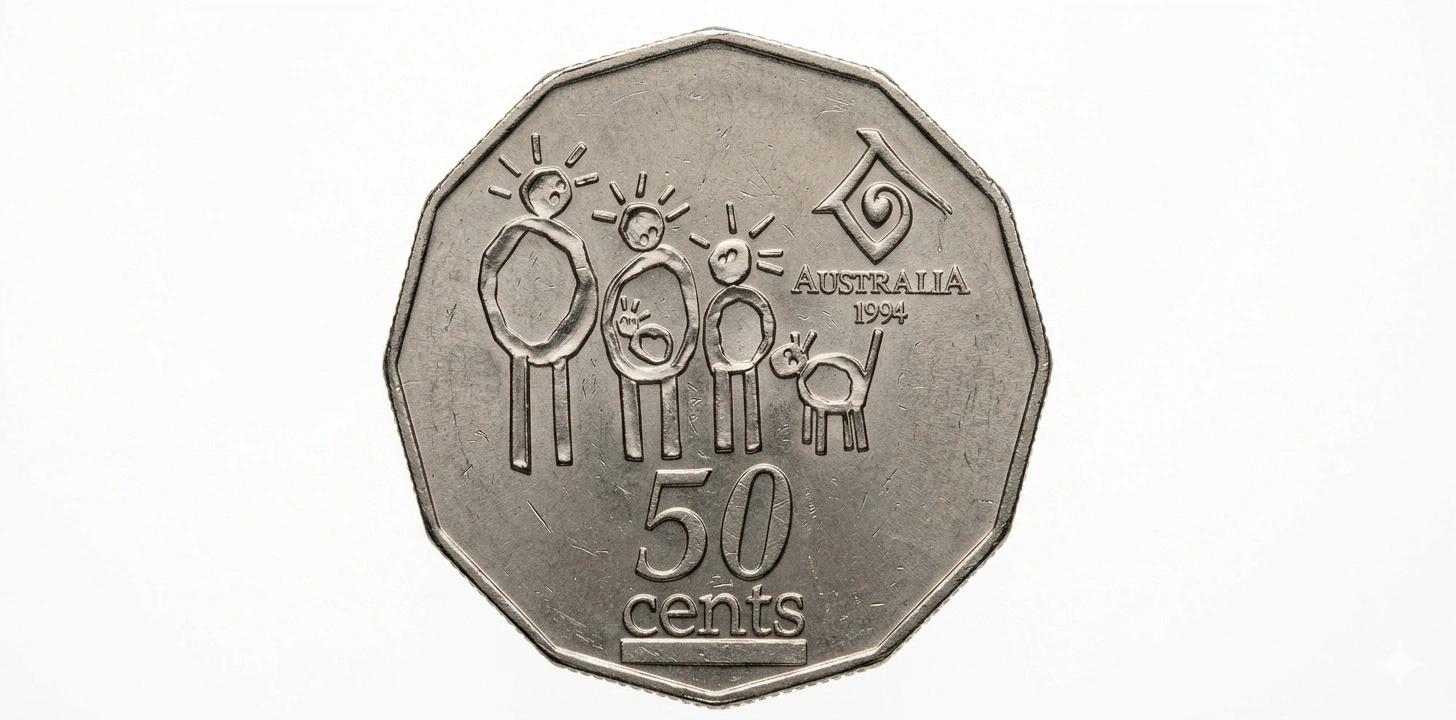
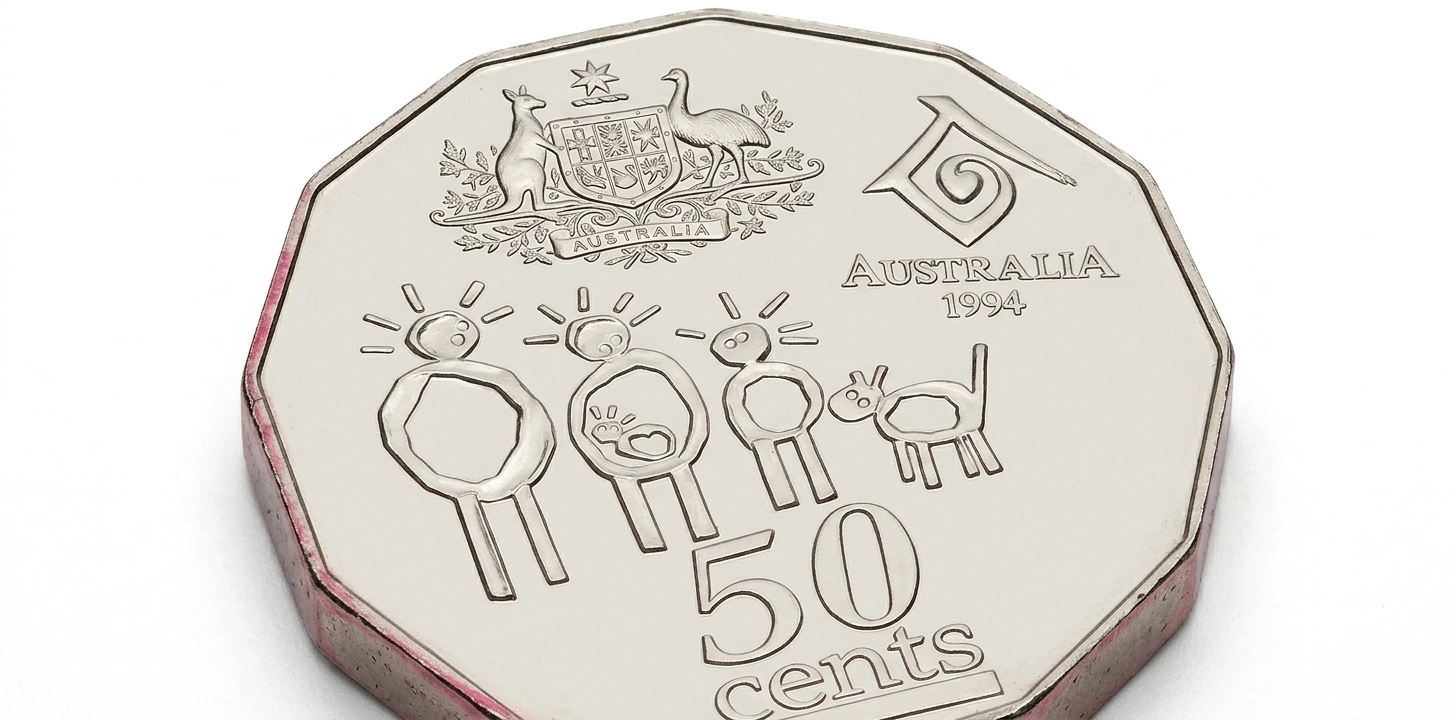
1994 Year of the Family: a coin with a narrow distribution circle
Prices reach $45.00 AU in Uncirculated condition.
2017 Ford/Holden Series: colored thematic sets
Set prices grew by 450% from the initial cost over 7 years.
Colored coatings on Australian coins remain extremely sensitive to wear.
Specimens with fully preserved paint in 2026 are valued three times higher than worn ones.
Scarcity Through Withdrawal: The 1986–1993 Era
The mint produced 50-cent coins exclusively for collector sets during this period.
These years never officially entered circulation.
Finding such a coin in change indicates the opening of a set by a previous owner.
1986: mintage of 65,000 units (sets only)
1991: mintage of 45,000 units (sets only)
1993: mintage of 35,000 units (sets only)
One 1993 coin taken from a set costs $115.00 AU in 2026.
Market values for complete sets always exceed the sum of individual coins inside.
Breaking a set to sell coins separately remains economically disadvantageous.
Verification Methods and Counterfeit Protection
High values for rare 50-cent coins provoke the appearance of counterfeits.
Most fakes originate from casting or laser engraving methods.
Authenticity Verification Algorithm:
Comparing weight against the standard 15.550 grams
Checking the edge count and sharpness of the dodecagon corners
Examining the rim for the absence of casting seams
Analyzing the legend font with the free coin apps
1966 Silver fakes often show low weight due to the use of cheap alloys.
Portable X-ray analyzers in 2026 allow for determining metal composition without damaging the coin.
Precision in determining silver content reaches 99.9%.
Royal Australian Mint (RAM) Governance
The official coin producer shapes the market through limited series releases.
RAM actively collaborates with commercial banks to withdraw old coins.
Updating the obverse design due to the monarch change sparked interest in Elizabeth II issues.
Late-reign coins with low mintage figures are already valued above face value.
→ 2023 release → Transition portrait → Limited minting time → Price rise
RAM’s control over mintage volumes ensures market predictability.
Publishing annual reports allows investors to react to shortages in time.
Australia vs New Zealand
Australian 50-cent coins possess higher mass and a unique shape.
The Australian market exceeds the New Zealand market in trade volume by 8 times.
This makes Australian coins a more liquid instrument.
Selling a rare Australian coin quickly is possible within 48 hours.
Finding a buyer for rare New Zealand coins might take up to a month.
Investors prefer markets with high transaction intensity.
Storage Technologies and Preservation
Oxidizing Copper and Nickel alloys leads to the appearance of dark spots.
Losing aesthetic appeal reduces a coin's price by 40–60%.
Conservation Recommendations:
Using acid-free paper envelopes
Storing in vacuum cases with humidity below 30%
Excluding skin contact by using gloves
Rejecting chemical cleaning with home remedies
Any mechanical impact leaves microscratches.
Grading specialists immediately identify cleaned coins.
Cleaned coins receive a Details mark, losing their investment attractiveness.