
The US numismatic market regarding the half dollar denomination demonstrates a strict dependency on grade, die rarity, and current certified population levels.
A 50 cent coin value chart compiled from PCGS and NGC data indicates significant volatility within the upper segments of the Sheldon scale.

Total production volumes for half dollar coins varied according to economic conditions and metallic composition.
Silver issues produced until 1964 possess intrinsic value determined by global bullion market spot prices.
Coin Type | Production Period | Primary Metal | Average Mintage (Millions) |
Walking Liberty | 1916–1947 | 90% Silver | 12.5 |
Franklin Half | 1948–1963 | 90% Silver | 30.2 |
Kennedy Half | 1964 | 90% Silver | 429.5 |
Kennedy Half | 1965–1970 | 40% Silver | 150.0 |
These figures indicate an oversupply of 1964 Kennedy halves, limiting investment potential in mid-range grades.
Walking Liberty Series (1916–1947)
Walking Liberty coins show the most consistent growth in grades MS66 and higher.
Pricing for specimens in AU58 condition (borderline preservation) remains stagnant, showing annual changes within 1-2%.
Key Date Valuation Dynamics
Examining rare dates requires focusing on the 1921 issues struck at three different mints.
1921-S (San Francisco): Having a mintage of 544,000 pieces the price in VG8 grade stands between 150–200 dollars.
MS65 Grade: Valuation reaches 40,000–55,000 dollars depending on toning presence.
Record: A 1921-S specimen graded MS66 sold for 188,000 dollars in 2016.
Value appreciation for MS65 specimens averages 4.5% annually over the last decade.
Franklin Half Dollar Market Prices (1948–1963)
The primary pricing factor for the Franklin series remains the presence of Full Bell Lines (FBL).
Lack of sharp lines on the reverse reduces coin value by 50–70% in high grades.
Grade | Without FBL (USD) | With FBL (USD) | Price Difference (%) |
MS63 | 25 | 45 | +80% |
MS65 | 50 | 185 | +270% |
MS66 | 120 | 650 | +441% |
MS67 | 800 | 4,500 | +462% |
Statistical data confirms exponential price growth upon reaching the MS67 FBL threshold.
Inflationary expectations for 2025 suggest a price correction for MS64 Franklin coins by -2% caused by market oversaturation.
Kennedy Half Dollar Series (1964–Present)
Kennedy coins struck from copper-nickel clad after 1971 contain no precious metal.
Their valuation derives exclusively from the scarcity of specimens in MS67 and MS68 grades.
Kennedy Coin Auction Records
The 1964 Accented Hair variety found on proof coins remains a high-demand target.
1964 SMS (Special Mint Set): Possessing a satin finish extremely rare for this year.
Price Record: A 1964 SMS specimen in SP67 grade sold for 156,000 dollars in 2019.
1970-D: Issued only in mint sets the MS65 price sits at approximately 50 dollars.
Average annual price decline for common Kennedy coins in MS63 grade reaches 5% due to new bank bags being opened annually.
Price Chart Forecast
The 2025 forecast relies on analyzing the "Population Report" of graded coins.
Increasing numbers of certified coins in MS66 grade reduces the rarity premium.
Factors Adjusting the 2025 Price Chart
Market Saturation: Growth in graded coin supply by 8% annually slows price increases in the sub-500 dollar segment.
Bullion Reserves: Rising silver prices by 10% automatically increases the base value of 1964 coins by an identical percentage.
MS68 Scarcity: Discovery of a new MS68 specimen potentially crashes previous record prices by 20-30%.
Description of Rare Varieties
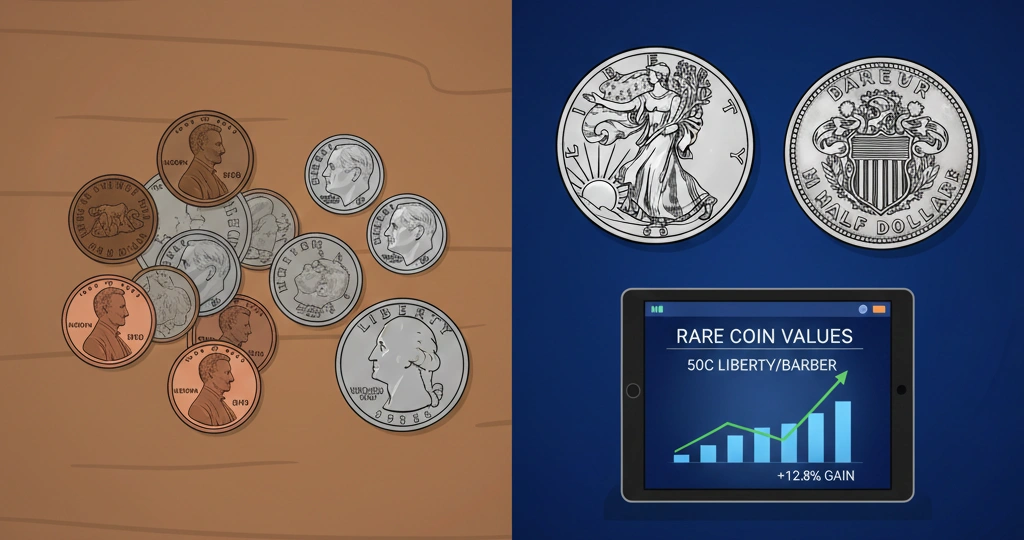
Mint errors confirmed by leading laboratories create significant price spikes that you can check at home with the coin appraisal app.
Doubled Die
Doubling of the "In God We Trust" inscription or the date significantly increases market appeal.
1961 Franklin Half Dollar Proof (DDR): Doubling on the reverse lettering. Price in PR67 grade reaches 3,000 dollars.
1943 Walking Liberty (DDO): Obverse doubling. An MS65 specimen costs approximately 2,500 dollars showing 3.5% annual growth.
Using macro photography reveals die defects invisible to the naked eye but critical for valuation.
Influence of Mints on Price Hierarchy
Coins bearing "S" (San Francisco) or "D" (Denver) marks often value higher than Philadelphia issues (no mark) due to lower mintages.
Mint Mark | Mintage (pcs) | MS65 Price (USD) |
Philadelphia | 6,028,800 | 165 |
Denver | 491,600 | 750 |
The Denver mintage being 12 times smaller than Philadelphia creates a 354% price gap.
In 2025 this gap is expected to widen by 1.2% reflecting the removal of rare coins from private collections.
Preservation Grading Methodology
Coin liquidity is determined by the speed of sale at prices near catalog values — you can see the particular info details with the coin value app.
Coins in grades below XF40 possess low liquidity trading at metal value.
Value Loss from Mechanical Damage
The presence of a single deep scratch on the coin field reduces its grade to "Details" (lacking a numeric grade).
Price Loss: Market value reduction ranges from 60% to 85%.
Cleaning: Using chemical agents to clean the surface destroys the original mint luster.
Consequences: Cleaned coins lose investment asset status being excluded from price growth charts.
Long-Term Trend (2015–2025)
The ten-year cycle shows a market split into "investment" and "expendable" segments.
The investment segment (coins valued above 2,000 dollars) grew by 42% during this period.
The expendable segment (coins under 100 dollars) lost 15% in real value considering inflation.
Percentage Value Change by Category
Key Dates: +5.2% per year.
Varieties: +4.1% per year.
Common Dates: -0.5% per year.
The 2025 half dollar value chart reflects silver price stabilization and a shortage of high-end grades.
The absence of new major Walking Liberty coin hoards fixes current price floors.
Further upward price movement remains limited by purchasing power within current economic cycles.
Investors should reference confirmed sales on the Heritage Auctions platform over the last 24 months to build an accurate portfolio.